EU CRA for industrial component manufacturers
Know your component's class under the EU CRA and what each OEM gets from you.
For suppliers of drives, sensors, I/O modules, controllers and chips: most components are default class under the Cyber Resilience Act. Classes I and II cover network interfaces, routers, managed switches, firewalls and chips with security functions; secure elements are critical. With the duties of the component maker and the documents OEMs need.
Last reviewed:
- Applies in full
- 11 December 2027
- Early warning
- 24 hours · Art. 14(2)(a)
- Support period
- at least 5 years · Art. 13(8)
- Most common class here
- Default product
Is a component placed on the market separately a product with digital elements?
A component that its manufacturer places on the market separately is a product with digital elements under the Cyber Resilience Act (Art. 3(1)), as long as its intended use involves a direct or indirect data connection to a device or network (Art. 2(1)). A microcontroller sold to device makers, a drive with an EtherCAT port or an IO-Link sensor therefore needs its own conformity assessment and its own vulnerability handling under Art. 13 EU CRA. The machine builder that integrates it is the manufacturer of the machine (EU Commission guidance, chapter 4, Example 51). The regulation is applicable in full as of 11 December 2027.
Product classes
Which industrial components are default class, and which fall under Annex III?
Microcontrollers, network interfaces and switches are where Annex III of the Cyber Resilience Act reaches component suppliers. Class I lists physical and virtual network interfaces (point 10), routers and switches (point 12), and microprocessors, microcontrollers, ASICs and FPGAs with security-related functionalities (points 13 to 15); Implementing Regulation (EU) 2025/2392 gives the technical descriptions. Drives, sensors, encoders, I/O modules, HMIs and PLCs have no category there, so core functionality puts them in the default class (Art. 7(1) EU CRA; EU Commission guidance, chapter 6).
Spread in this sector
Pick a product
Frequency inverter or servo drive with fieldbus
Why this class
No Annex III or IV category; self-assessment under module A (Art. 32(1) EU CRA).
Conformity route
- 1Risk assessment
- 2Self-assessment (module A)
- EU declaration of conformity + CE
Self-assessment by the manufacturer, Art. 32(1) EU CRA.
An assessment based on typical core functions. Your product's intended purpose and design decide.
All product examples as a table+
| Product | EU CRA class | Why |
|---|---|---|
| Frequency inverter or servo drive with fieldbus | Default product | No Annex III or IV category; self-assessment under module A (Art. 32(1) EU CRA). Product page → |
| PLC, I/O module or HMI panel | Default product | Annex III names no controllers or operator panels. Product page → |
| IO-Link sensor, encoder or light barrier | Default product | In scope through its data connection, with no category in Annex III or IV. |
| Industrial machine vision camera | Default product | No category; item 17 only covers cameras that protect security in homes. |
| Transducer or power meter with Modbus | Default product | No category in Annex III or IV. |
| Microcontroller without security-related functionalities | Default product | Under Implementing Regulation (EU) 2025/2392, item 14 requires functions that secure other products, networks or services. Secure boot, a TEE or crypto functions that protect other parts already qualify. |
| Microcontroller, microprocessor, FPGA or ASIC with security-related functionalities | Important product, class I (Annex III) | Annex III, class I, points 13 to 15 EU CRA. |
| Network interface card, fieldbus or radio module sold separately | Important product, class I (Annex III) | Physical network interfaces, Annex III, class I, point 10; Implementing Regulation (EU) 2025/2392 names fieldbus, Wi-Fi and Bluetooth explicitly. |
| Managed industrial switch or router | Important product, class I (Annex III) | Annex III, class I, point 12; switches only with a management plane (Implementing Regulation (EU) 2025/2392). |
| Industrial firewall or intrusion prevention system | Important product, class II (Annex III) | Annex III, class II, point 2 EU CRA. |
| Tamper-resistant microcontroller or microprocessor | Important product, class II (Annex III) | Annex III, class II, points 3 and 4 EU CRA. |
| Secure element | Critical product (Annex IV) | Annex IV, point 3: smartcards or similar devices, including secure elements. |
Your product isn't listed? The maturity assessment gives a first classification for your own product. Start the EU CRA assessment →
Out of scope are components whose intended use involves no data connection of any kind, and products covered by vehicle type-approval under Regulation (EU) 2019/2144 (Art. 2(2)(c) EU CRA). Components placed on the market before 11 December 2027 only come under the requirements after a later substantial modification (Art. 69(2)).
Obligations
What does a component manufacturer have to hand over to OEM customers?
Under the Cyber Resilience Act, an OEM has to exercise due diligence on every component it buys in (Art. 13(5)). Recital 34 lists what that can involve: checking the supplier's proof of conformity and CE marking, its record of security updates, and whether the component is free of vulnerabilities listed in public databases.
- 01
The declaration of conformity and CE marking
Art. 13(12) and Art. 32 EU CRA
The component manufacturer completes the conformity assessment that its component's class requires under Art. 32 and then issues an EU declaration of conformity and affixes the CE marking (Art. 13(12) EU CRA). OEMs can file both straight into their due diligence record.
- 02
Instructions written for the integrator
A component intended for integration ships with what an integrator needs to meet Annex I and compile its Annex VII technical file (Annex II, point 8(f)), plus the support end date (point 7). That information stays available for at least ten years after placing on the market, or for the support period if longer (Art. 13(18) EU CRA).
- 03
Support period and end date
The support period lasts at least five years under Art. 13(8) EU CRA, and its end date is given at purchase as at least month and year (Art. 13(19)). OEMs may factor in the support periods of bought-in components that provide core functions when setting their own (Art. 13(8), second subparagraph). Each security update released stays available for at least ten years (Art. 13(9)).
- 04
A software bill of materials per product
The Cyber Resilience Act requires an SBOM in a commonly used, machine-readable format that covers at least the top-level dependencies (Annex I, Part II, point 1). Publishing it is not required (Recital 77). If the manufacturer shares it with users, the Annex II information says where to access it (point 9).
- 05
A contact point for vulnerability reports
Art. 13(6); Annex I, Part II, points 4 and 6 EU CRA
An OEM that finds a vulnerability in a bought-in component must tell its manufacturer and share any fix it has built (Art. 13(6) EU CRA). The supplier needs a contact address for such reports (Annex I, Part II, point 6) and, after each security update, an advisory naming the affected product, impact and severity (point 4).
Related regulation
How does the Cyber Resilience Act fit with the Machinery Regulation and the RED?
Machinery Regulation (EU) 2023/1230
A product that is also in scope of the Machinery Regulation, such as a safety component, must meet both sets of essential requirements (Recital 53 EU CRA). Meeting the cybersecurity requirements can support sections 1.1.9 and 1.2.1 of Annex III to the Machinery Regulation (protection against corruption, safe control systems) if the manufacturer demonstrates the overlap.
Radio Equipment Directive 2014/53/EU
Wi-Fi, Bluetooth and cellular modules can fall under Delegated Regulation (EU) 2022/30, which activates the cybersecurity requirements of Art. 3(3)(d), (e) and (f) of the directive for certain radio equipment. According to Recital 30, the essential requirements of the Cyber Resilience Act include every element of those three. Art. 69(1) EU CRA keeps certificates on cybersecurity requirements under other harmonisation acts valid for a transition period.
NIS2 Directive (EU) 2022/2555
Operators covered by NIS2 must manage supply-chain security (Art. 21(2)(d) NIS2) and pass requirements down through machine builders to component suppliers. The supplier's own product obligations sit in the EU CRA.
In practice
Where component manufacturers get stuck
Upstream end of support
Chips, real-time operating systems and libraries have suppliers of their own. When their support ends early, their vulnerabilities stay with the component manufacturer, since Art. 13(8) of the Cyber Resilience Act covers a product's components.
Repeated OEM questionnaires
Every OEM that builds the component in checks it for its own product. Class, declaration, support end date and fix status come up again and again, each time in a new template.
Releases and variants in parallel
Hardware variants by power rating and fieldbus share one firmware platform, and older releases stay in service while new ones ship. Whether a given customer is affected depends on both variant and release.
Replacement parts in after-sales
After-sales teams decide part by part whether a replacement still matches the original or is a successor type with new firmware, and the call must hold up with market surveillance years later.
With Kunnus
How Kunnus supports component manufacturers
Worked example
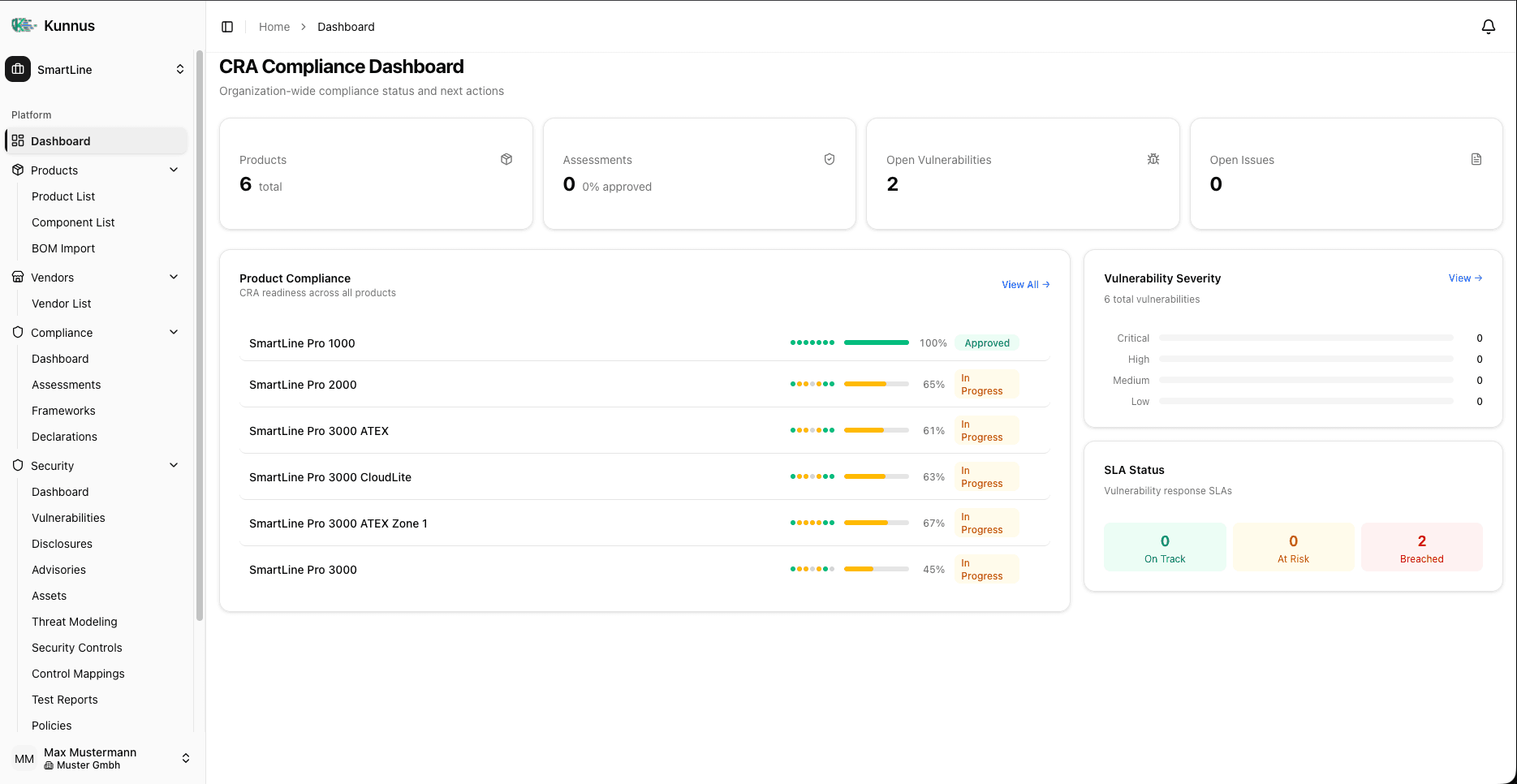
Worked example: 4 variants, 12 firmware releases, 25 OEMs
An encoder manufacturer runs one firmware platform on four hardware variants. The EU Commission guidance on the Cyber Resilience Act (chapter 2) treats a variant with its own components as a separate product.
- 1Products4 hardware variants
- 2Releases in the field12 (3 per variant)
- 3OEM customers25
- 4One platform vulnerability12 releases to check, 1 advisory, 25 customers who need it
- 5Each year4 new releases, while older ones stay in service
Illustrative assumptions, not industry statistics. Whether variants count as separate products depends on their components, configuration and enabled functions.
Products
Which products from this sector have their own page?
Frequently asked questions
Can we self-assess small electronic components under the Cyber Resilience Act?+
Self-assessment depends on the component's class. Default-class components such as sensors or I/O modules may use internal control, module A (Art. 32(1)). For class I, such as a security microcontroller, module A requires harmonised standards, common specifications or a certification scheme at assurance level substantial or higher, applied in full; otherwise module B plus C, or module H (Art. 32(2)). Class II parts such as tamper-resistant microcontrollers go through a third-party procedure (Art. 32(3)).
Does a security microcontroller inside our drive make the drive a class I product?+
A drive's class follows the drive's own core functionality. Integrating an Annex III product such as a security microcontroller does not on its own bring the host product under the procedures in Art. 32(2) and (3), as the second sentence of Art. 7(1) EU CRA states; the EU Commission guidance runs the same logic for a router with a firewall component (chapter 6, Example 63). The chip itself is classified by its own manufacturer, under Annex III, class I, point 14.
Do we have to report every vulnerability in our component to ENISA?+
Actively exploited vulnerabilities and severe incidents are the two triggers for reporting under Art. 14 of the Cyber Resilience Act, and the reports go to the coordinating CSIRT and ENISA at once through the single reporting platform. As of 11 September 2026, each one needs an early warning within 24 hours of becoming aware, a notification within 72 hours and a final report no later than 14 days after a fix is available (Art. 14(2)). Components already on the market are covered as well (Art. 69(3)). Other vulnerabilities stay in the supplier's own Annex I, Part II process.
Does the spare-parts exemption cover a replacement part with newer firmware?+
Spare parts are exempt under Art. 2(6) EU CRA when they replace identical components and are made to the same specifications. The EU Commission guidance (chapter 4) reads identical in terms of security-relevant properties: a new chipset with the same protocols and security mechanisms can still qualify (Example 38), while a different cryptographic implementation or secure-boot mechanism cannot (Example 37). The exemption also requires the part to be demonstrably supplied to repair an existing product, for instance with that product named in the order. A successor type sold through the regular channel is a new product.
How long do we have to support an industrial component?+
An industrial component needs a support period of at least five years under Art. 13(8) EU CRA, and longer if it is expected to stay in use longer. To estimate that use time, the manufacturer weighs reasonable user expectations and the nature of the product, and can also look at comparable products from other makers and at how long the operating environment stays available. The reasoning goes into the Annex VII technical file. The Commission can set minimum periods for specific product categories by delegated act.
Does an IEC 62443-4-2 certificate prove Cyber Resilience Act conformity to our OEM?+
An IEC 62443-4-2 certificate attests that an automation component meets the technical security requirements of that standard, and the OEM can file it with the component's security documentation. Presumption of conformity with the EU CRA comes from harmonised standards whose references are published in the Official Journal of the EU (Art. 27(1)). Towards the OEM, the EU declaration of conformity remains the proof.
Which class do your components fall into?
In a few minutes, the EU CRA assessment gives a first estimate of your components' product class and suggests next steps.
Further reading
Other sectors
EU CRA compliance in other industries






Source: Regulation (EU) 2024/2847 (Cyber Resilience Act), Official Journal of the EU. https://eur-lex.europa.eu/eli/reg/2024/2847/oj
This page is an orientation on the Cyber Resilience Act for this sector, not legal advice. Whether and how the regulation applies to a specific product depends on its intended purpose and design.